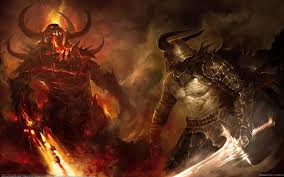
I view life as a constant fight between good and evil. With every decision you make, or with every road you take, you engage in battle as you try to reach your destination. There is good in the form of kindness, being unselfish, understanding, etc. Then there is evil which can exist in the form of greed, bad decisions, gluttony, etc. We don’t always choose evil on purpose. While there are different levels of evil, it is a battle in even the smallest of examples. For instance, if I get hungry, I know the right thing to do is think healthy but the idea of a juicy burger is too tempting to avoid. The evil in the example of eating fast food is that you know you shouldn’t do it, but the temptation is too much to bear. This is just a small example of evil winning a battle. Yes, in my eyes, good vs. evil can be intertwined with right vs. wrong. It can be, but not always. It isn’t wrong to eat unhealthy, it’s your decision if you want to live a long healthy life or a short one riddled with health issues.
The idea is that the struggle is always there in life. Every decision made is important. Every mistake must be learned from. Good vs. evil is always existent and it’s important to know you will not win every battle. You must win more than you lose.
Within every war lies the theory of Jus In Bello (Justice In War). This theory states what is morally acceptable behavior and proper conduct once the war starts. In general, it examines our behaviors or how we react (actions/decisions). Though this theory is based on actual war, I am using it as a philosophical idea behind the bigger war, which is, our own lives. There are two principles of Just In Bello.
1. Proportionality – which requires that means and ends are well matched. Example: Someone comes out of nowhere and slaps you! Did you deserve it? Did the ends justify the means? On a larger scale, it is widely believed that nuclear strikes can not be justified, but if successful, it might bring about a military objective (maybe ridding the world of an evil tyrant). Think about an example of this in your everyday life.
2. Discrimination – requires that combatants and non-combatants are strictly distinguished. For example: You are married and you had a bad argument with your spouse the night before. You go to work and take it out on everyone around you. The combatants in this case are you and your spouse. The non-combatants are your co-workers.
In general, it is possible for a just war to be fought unjustly, and an unjust war justly.
Jus In Bello dispels the notion that “anything goes” in war (life). There must be justice in war. Jus In Bello also requires that every agent must be held responsible for their actions.
(Cited: Ben Dupre “50 Philosophical Ideas”, Michelle Maiese “Jus In Bello”)
Your thoughts?
Lito Alva
 Still Searching For The Truth
Whoah this was amazing I read it twice! That’s is so true our everyday battle is our life!
_Dj-MiixMacias
Life is a battle Alex. Thanks for reading. I enjoy your input.
Back in the military, I had a fight with pure evil. This guy borrowed my wet weather pants, and never gave them back. I confronted the evil head on, and he denied ever borrowing them. In the end, I was out $40.00.
Care to give this individual’s name?
Lito!
Shut your blasphemous tongue!! I dispute these charges!!!
haha. punk.